HO Brass Wars, the
advent of the Brass Pan Ho Slot Car
(back
to riggenho.com)
-----
New additons to this section:
July 2007: Added new pages with the Kircher
Lead Sled, added info to the "Steve Schwartz
history lesson"
June 2007:
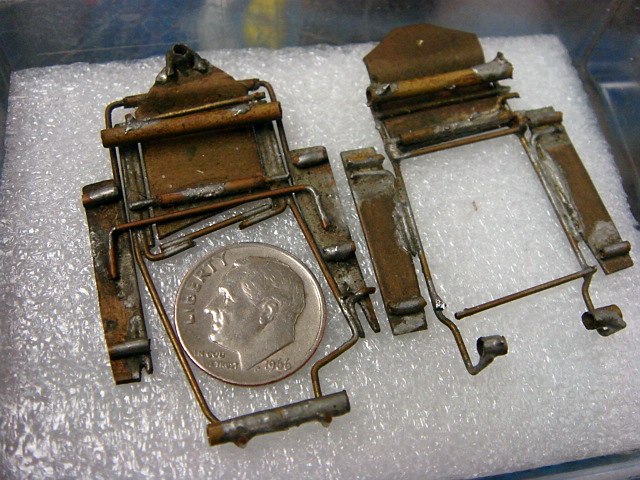
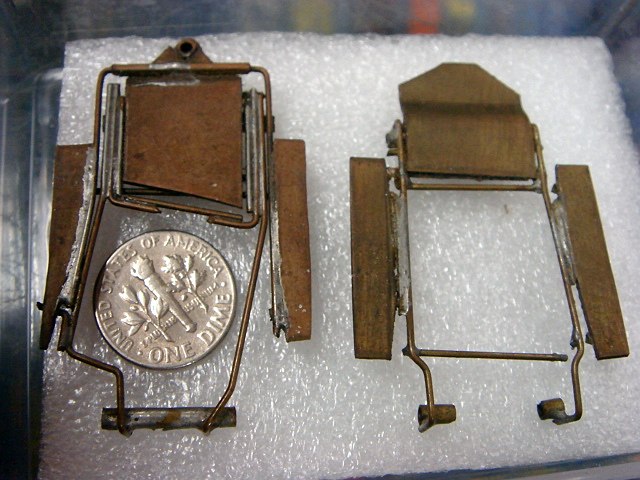
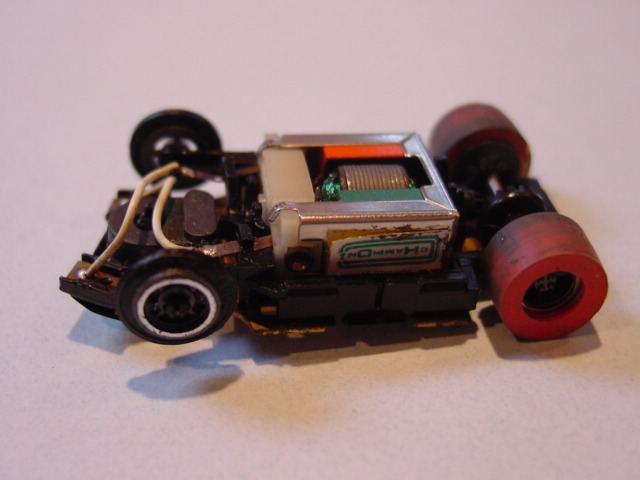
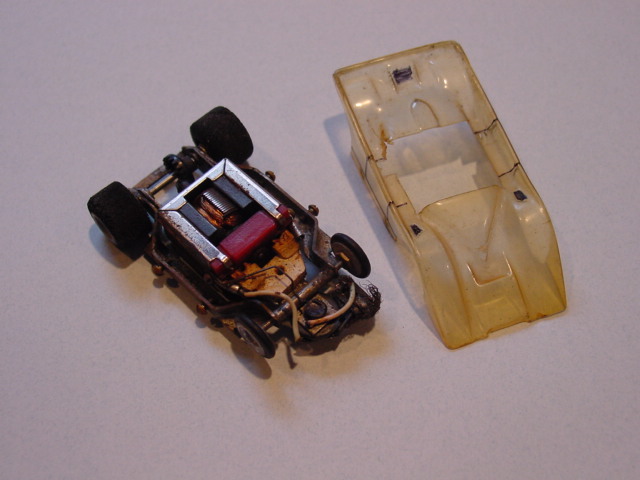
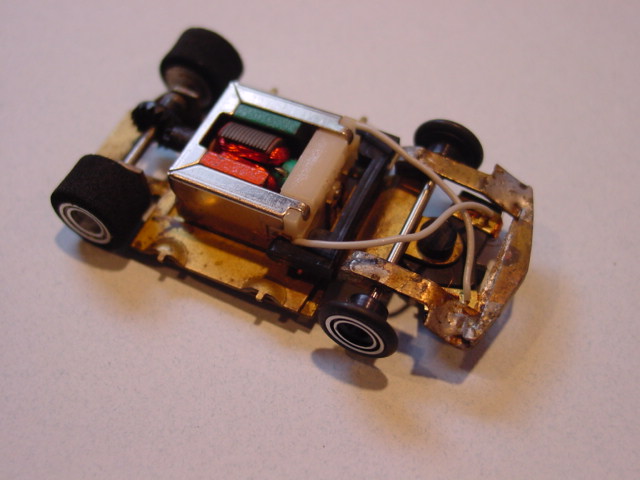
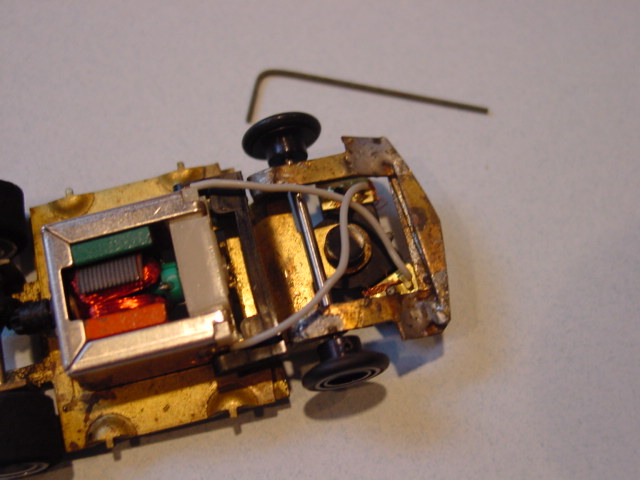
3 pictures of a car built by Mark Owyang(sp?). Don't know anything else...
pic 1 pic
2 pic
3
Mar 2007: Here are links to some pages from www.scratchbuilt.com
featuring HO handbuilts!
Ken
Webster Scratchbuilt Caprice
Steve
O'Keefe inline HO
Steve
O'Keefe Dragster w Cobramite body
The next few links are "linked through"
Micheal Ecksteins website
which has a ton of great info and pics on HO/Brass/Sctratchbuilt
HO
Quincy Anglewinder
HO
Quincy Inline design
Sep 2006: here is a link
to a thread on SlotBlog featuring a hand built ISO Riggen--looks fantastic
Sep 2006: Steven Schwartz history lessons
and pics
-------------------
Preface
--This information in the pages and links to follow was
collated largely from conversations and e-mails back and forth between myself
and a couple of Midwest and East Coast racers who were active in the late sixties
and early seventies. Additional information was gleaned through old articles
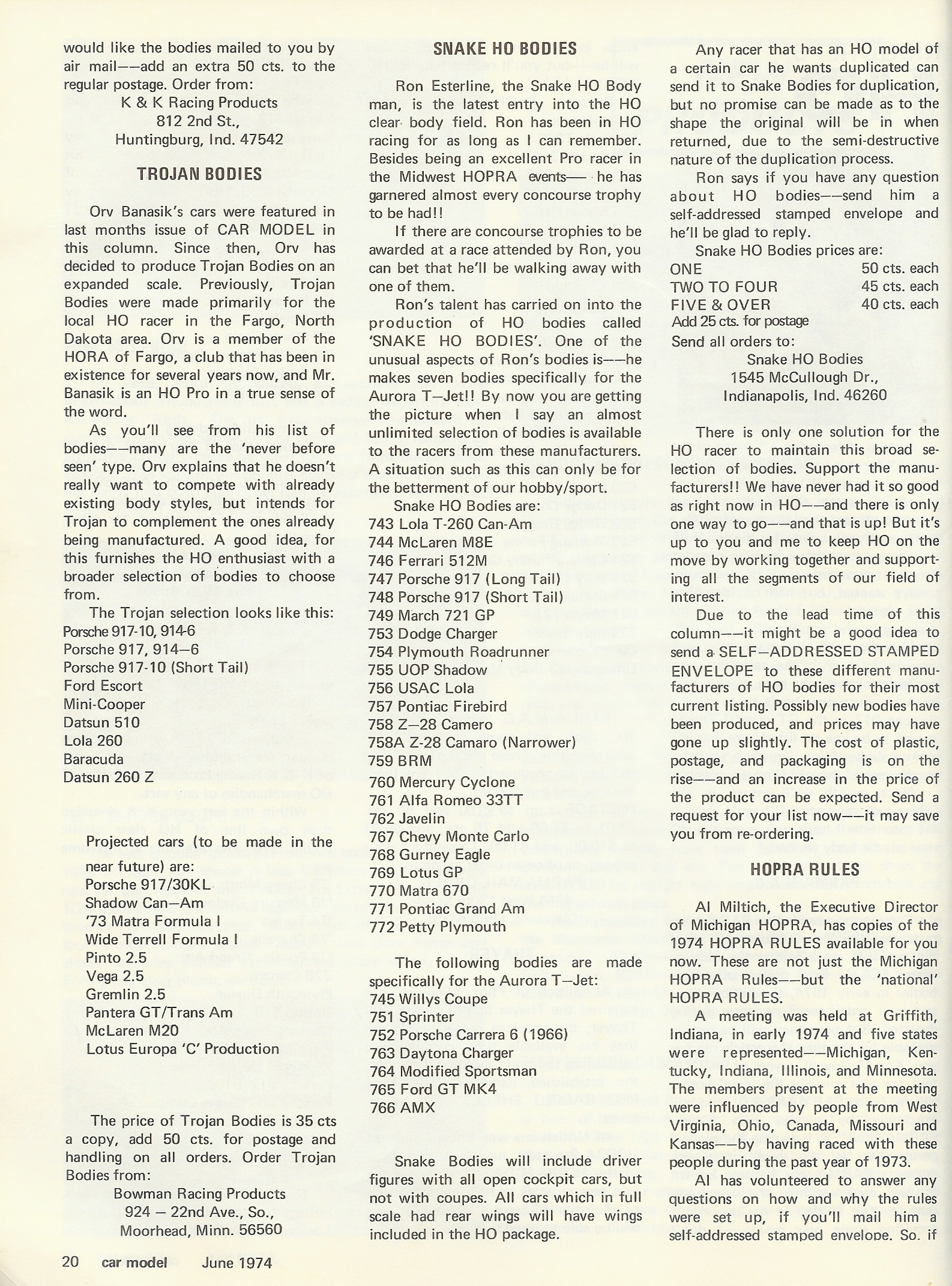
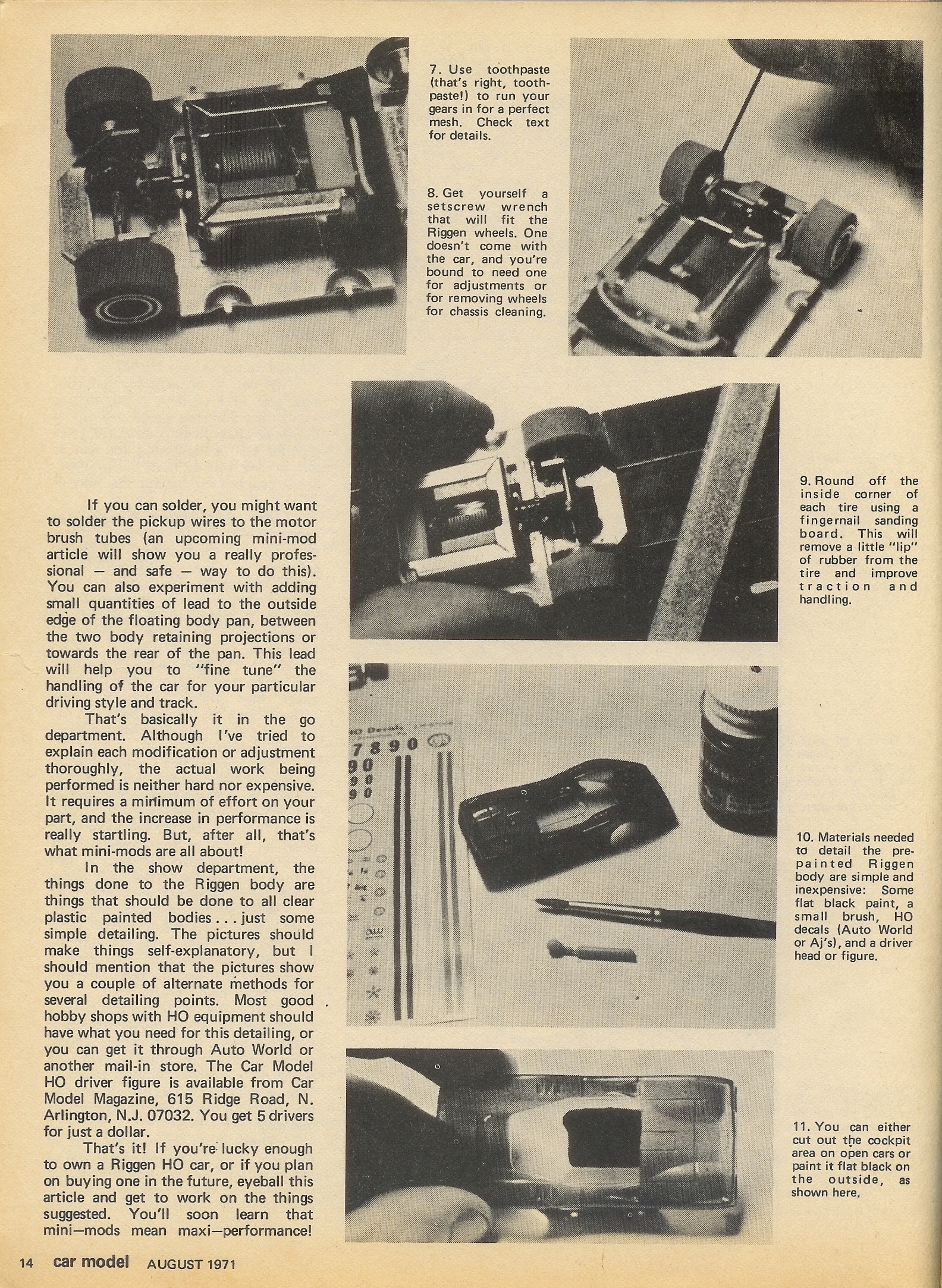
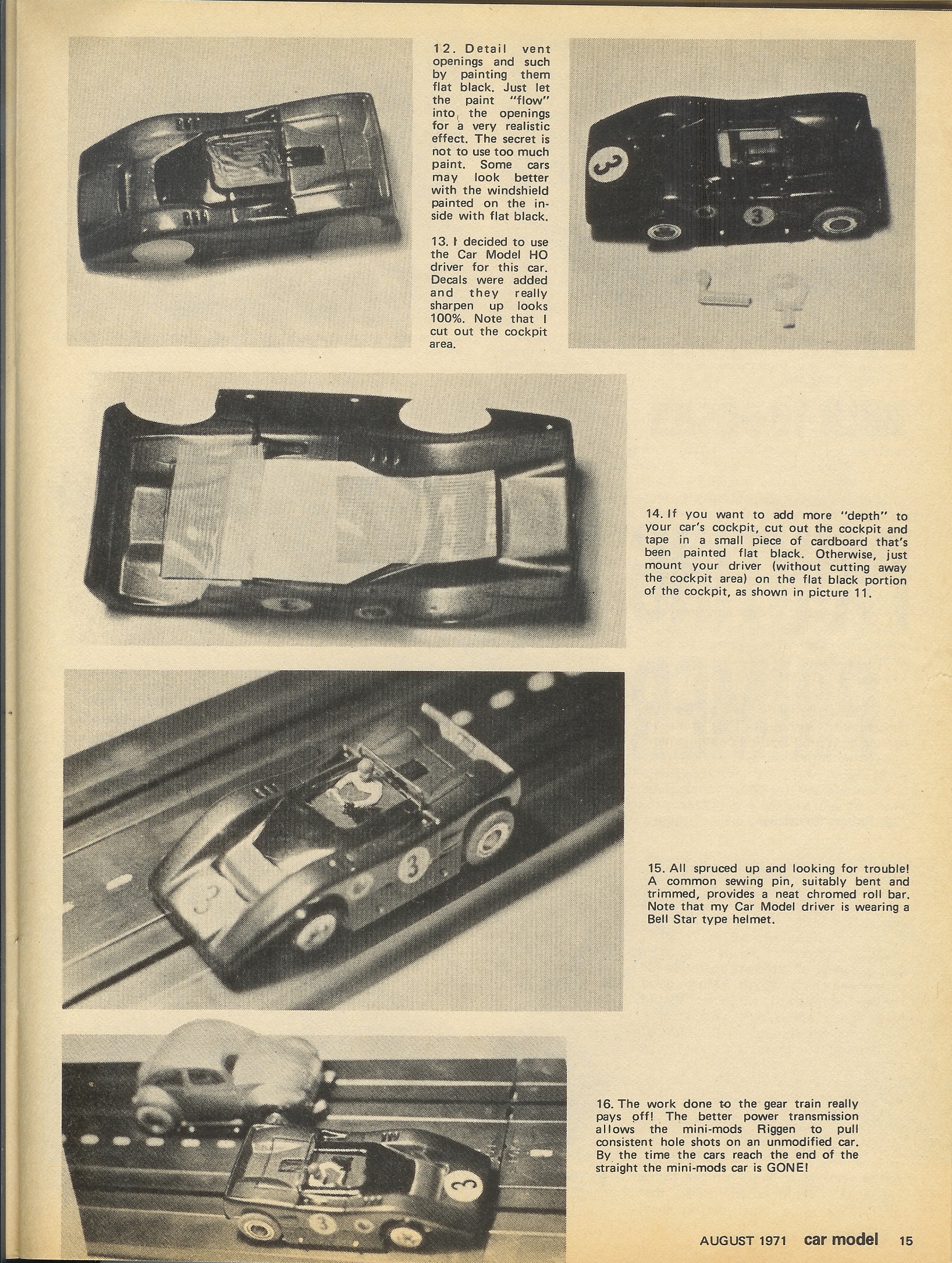
in Car Model magazine. Here is a link to a list
of relevant articles. The moniker "Brass Wars" seems appropriate beacuse
there were actually 3 (or more) different factions of racers beating their own
path of advancement in the hobby choosing BRASS as the material of choice for
chassis innovation and overall HO Slot car design. There
was (loosely defined) an "East Coast" group, a Mid-West group (HOPRA),
and a West Coast group.There was also a
fair bit of "trash talk" between the various groups in magazine columns
such as "Speed and Sport" and "HO Coast to Coast". Both
of my "real-live-person sources" raced in Hopra in the Mid-West.
By no means is this meant to be a thesis or a definitive history of an era of HO Slot Cars, it is primarily an attempt (backed by research and desire) to document, preserve, and understand this era. It is also an effort to educate and inspire others to document and converse. Any information you have to help enhance and complete this reference will be greatly appreciated--and of course referenced. Contact me at ron@riggenho.com

Introduction
and Timeline
--The basic timeline milestones for HO slot cars begin with the 1958 introduction
of the Playcraft line in Englad, followed by Aurora's licensing of the product
and their further development with the launch of "Vibrators" in 1960
followed by their "pancake chassis design" T-Jets in 1963. Aurora
had great commercial success with their line of HO scale slot cars and improved
them gradually through 1972, finishing with their ultimate T Jet called the
Super2.
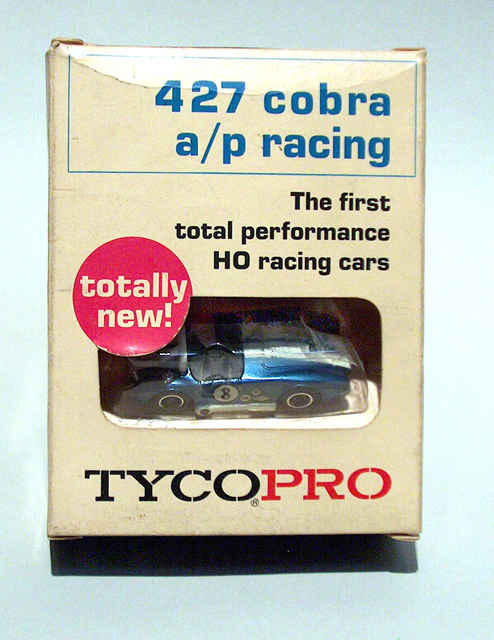
Tyco began competing with Aurora with their TycoS range launched in 1963 and
then in late 1970 introduced their brass pan TycoPro
in-line chassis design. TycoPro carried Tyco's range of slot cars through the
mid seventies. It is the period of time beginning around 1968 through the mid
1970's that the Brass Wars focuses on, led by an important engineering realization:
These
little cars can be made to go fast and the faster they go, the lower the center
of gravity needs to be or else they fly off the track around turns. So.........Brass
is heavy and strong and machineable, lets stick brass on the bottom of the chassis
see what happens!
Hence: The HO Brass Wars Era!
The technical revolution for HO slots after the Brass Era (really evolving from the brass era) changed everything in terms of speed and performance: the introduction of the traction magnet car. While no hard dates can be set for the end of one era and the beginning of another, it is fair to identify "late 60's/mid 70's" (consistent with time period of the fastest commercial growth of HO Slot Car racing) as the heydey of Brass Wars Era.
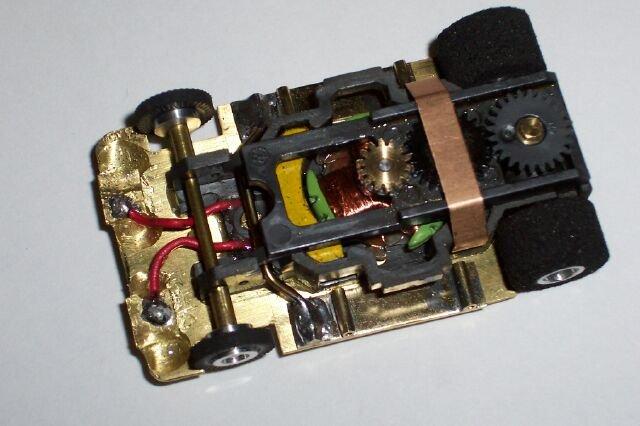
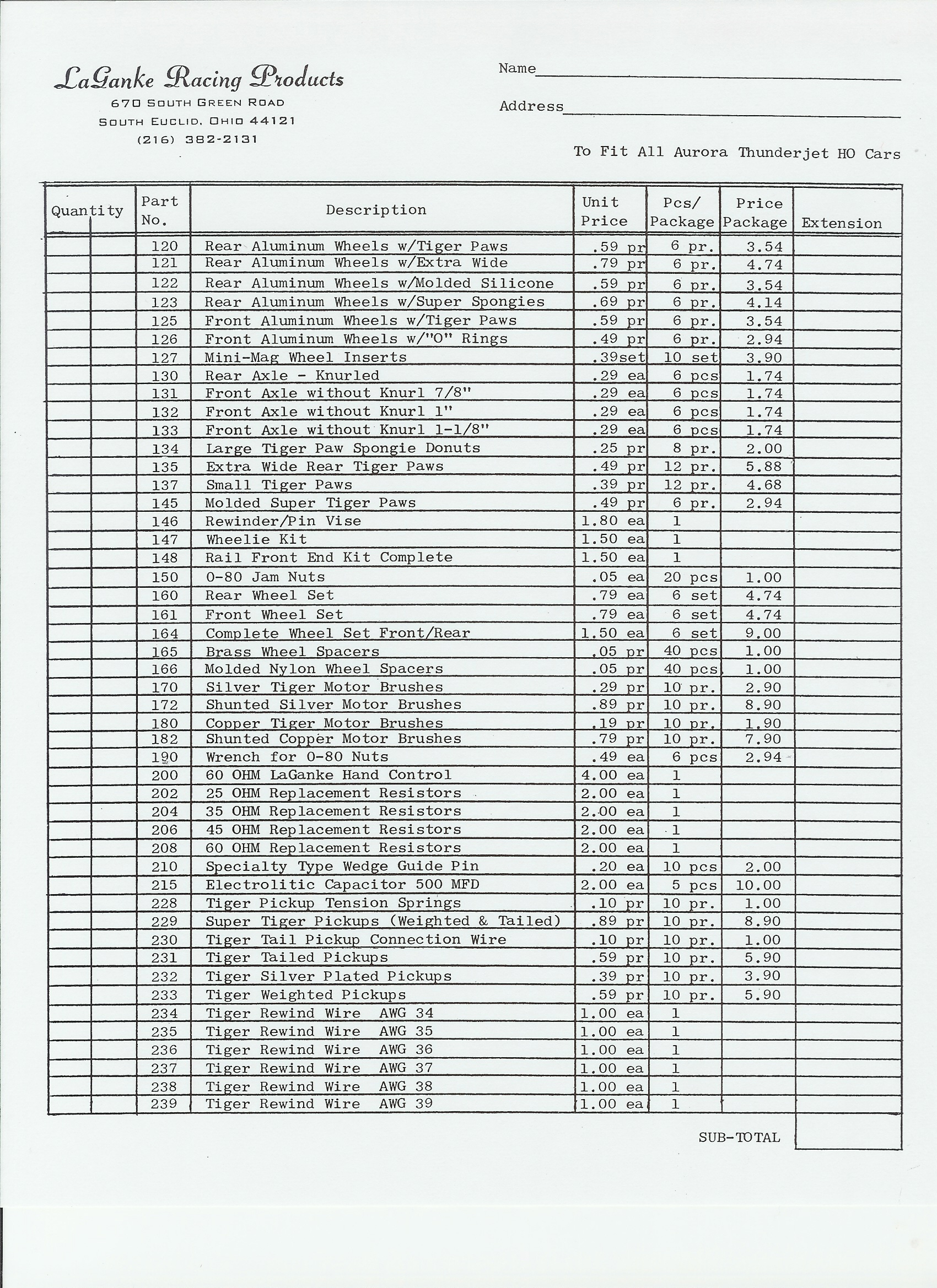
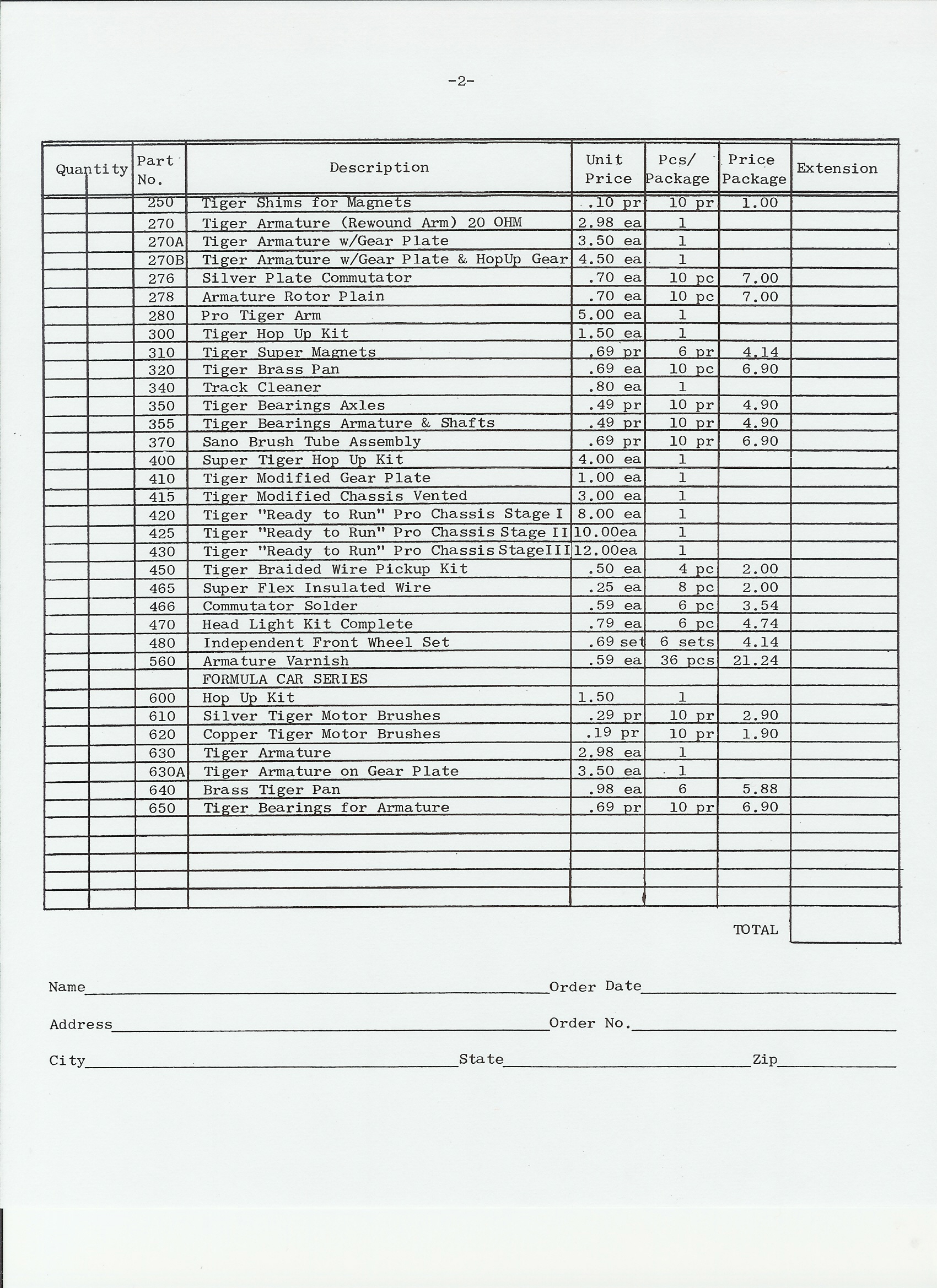
Aurora's T Jets first got a taste of brass when a few clever hop up parts makers (AJ's, Champion, Mura, Laganke) designed screw on brass pans that typically used the body mount screws to secure a shaped brass pan to the bottom of the Tjet chassis. This added weight to the bottom and helped the cars stick...Cost effective, pragmatic, and a definite increase in performance.
The TycoPro was already designed on a brass platform so Tyco was already vested in the merits of brass (along with an inline motor). The design and the hop up flexibility of the TycoPro soon made this chassis the "pro-racer's" choice as a starting point for custom chassis' until the Riggen Boss (see below) was introduced. Aurora was the money leader in this game with the most to lose so they were forced to respond---and made a valient attempt with the Super 2------ with mixed results. Brass Panned cars were now winning all the races---and naturally the hobby had to follow.
More Geography
and the "Commercials"
--While the East Coast had the big commercials Aurora and Tyco, the West Coast
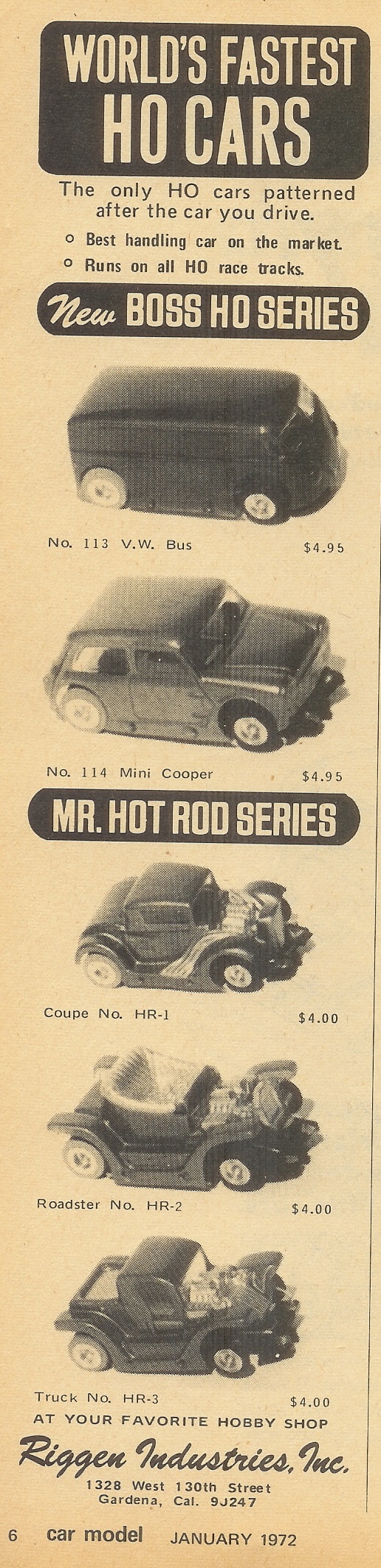
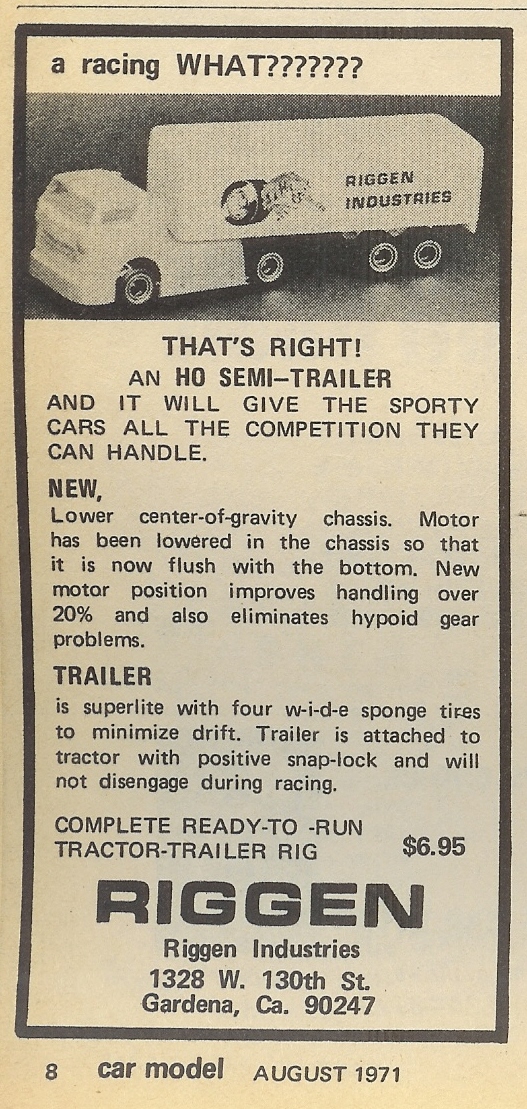
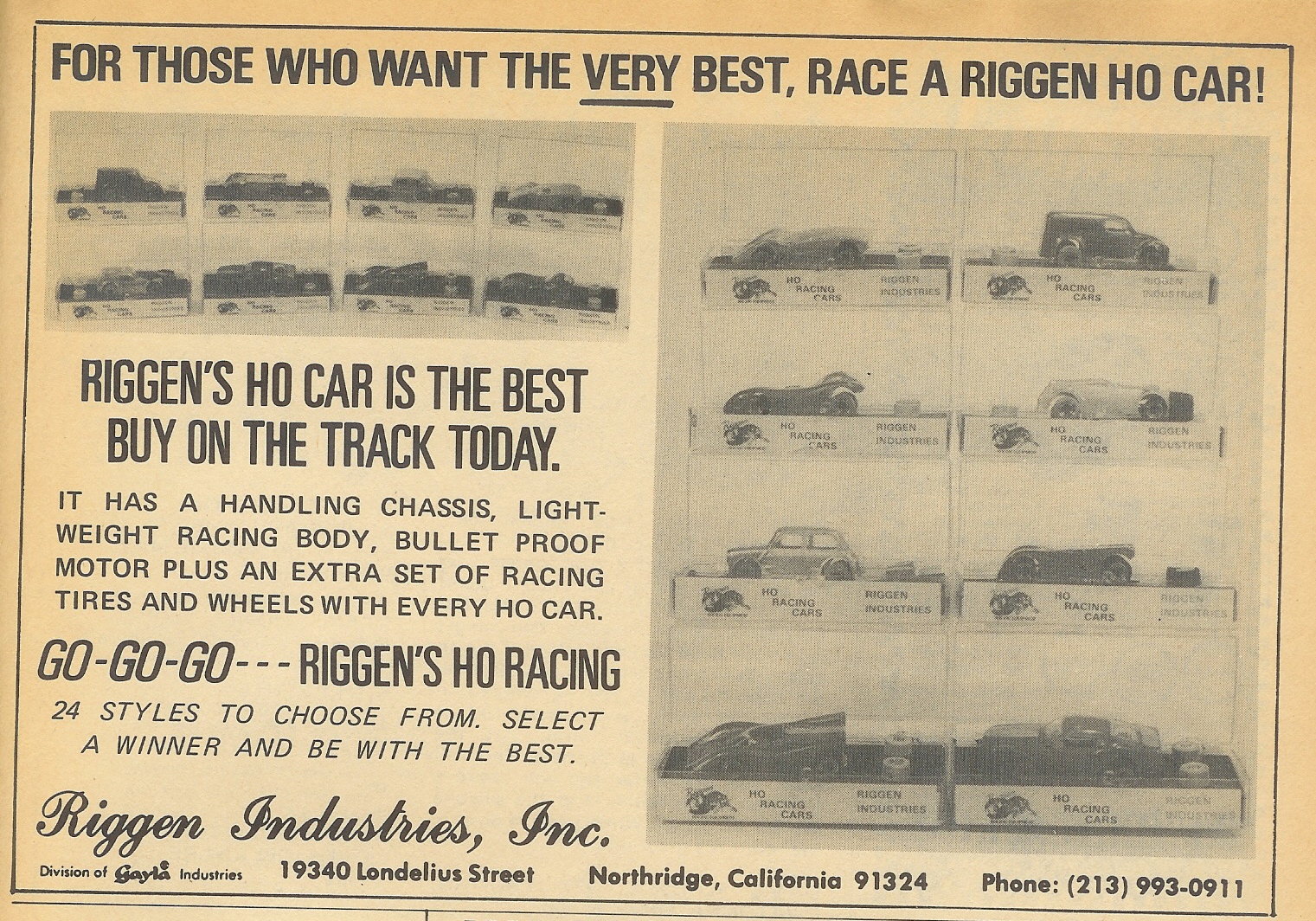
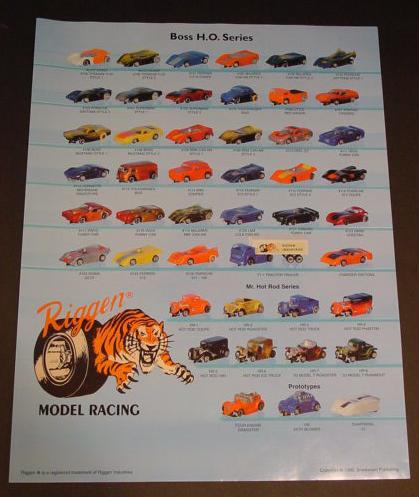
Brass was represented by two large scale makers. Riggen
Industries who brought out their Boss Ho
chassis, and Dynamic with their "Checkered Flag" Dynabrutes
. Cobra,
also a large scale parts and cars veteran was based in the East but sort of
sided with the designs of their West Coast brethren introducing an HO "ISO"
style brass chassis called the Cobramite.
While there are no large commercials from the midwest, the area was very active
in racing and parts development. Many "cottage
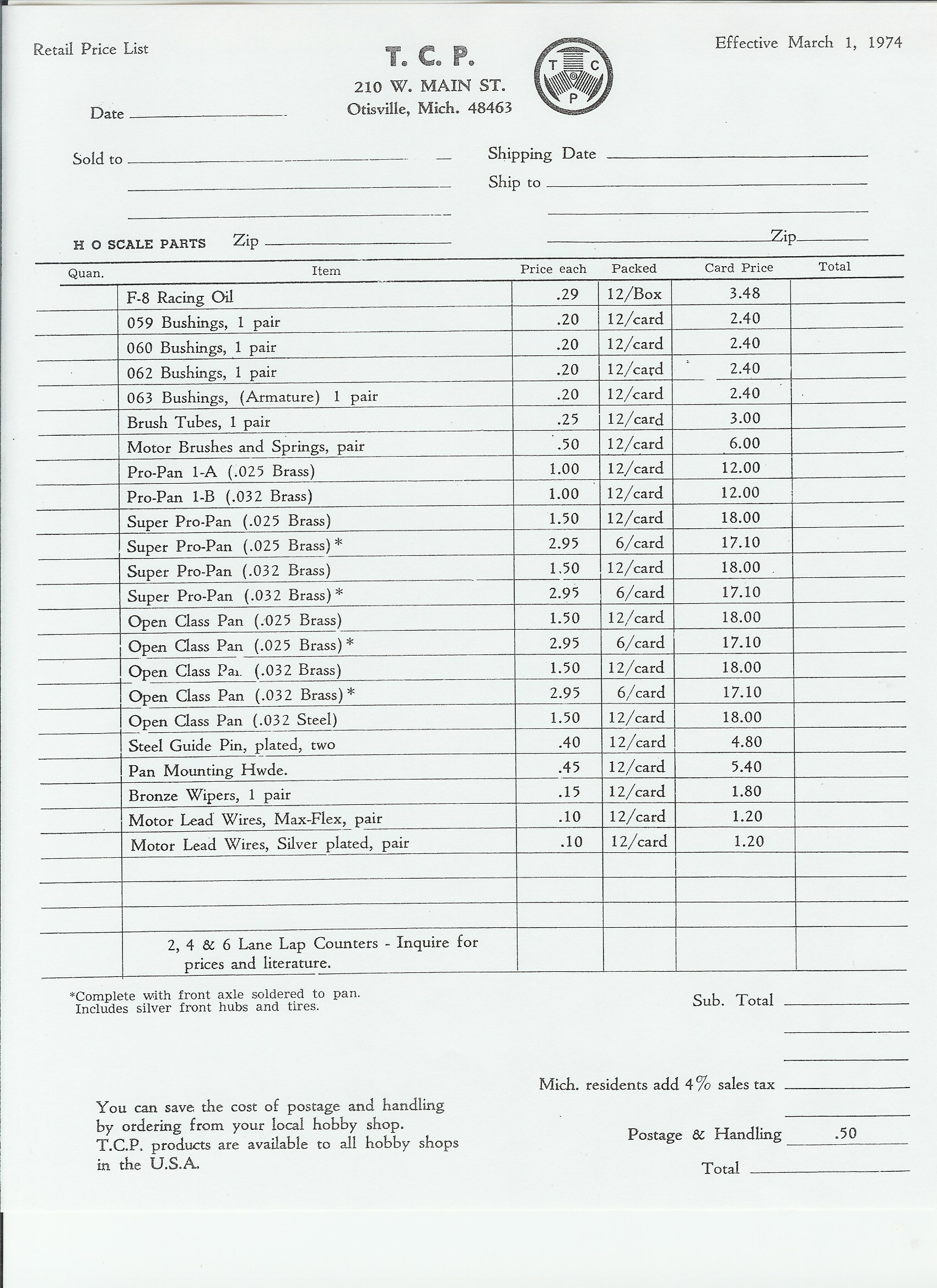
industry" participants sprang up here including TCP,
Laganke, Bronzeman, Bamberg Engineering, K and K,
and more.

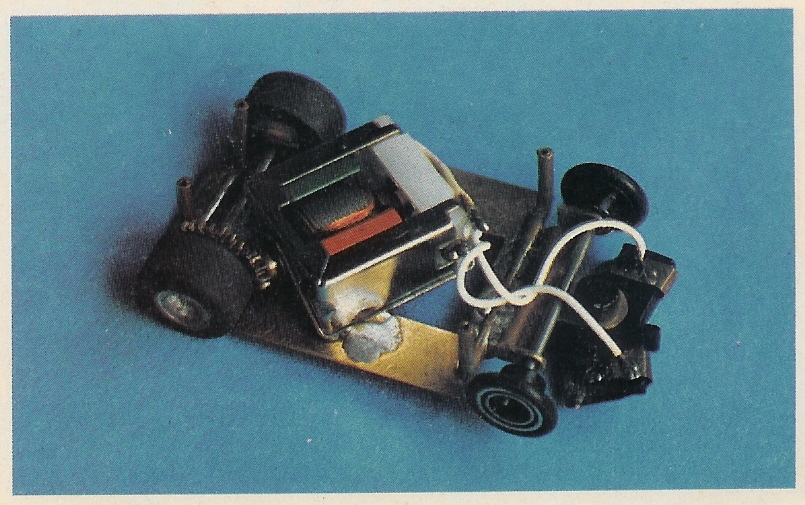
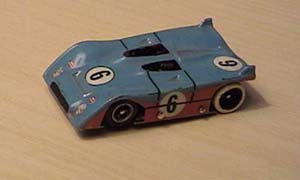
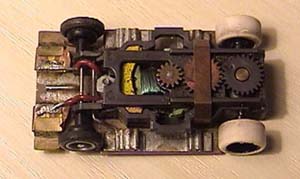
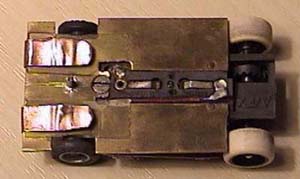
(Dynabrute, Riggen Boss, Cobramite and Super2)
Engineering
Advancements Achieved with the Brass Wars Pan cars...
--lower center of gravity
--floppy light bodies, also to remove the track vibrations and let the car run
smooth
--wider rear sponge tires for better traction (the jam
nut was INSIDE the rim, allowing more wheel!)
--lightweight aluminum independant fronts for less friction
--rewound engines such as Laganke, Bamberg
--(later development) lower magnets, first thought just to further lower the
COG, but then realized that the magnets stuuck to the steel rail/braids too!
Conversational History...
These excerpts are as told by DM to RB 3/2005……
…Really what the order was this: T-jets with screw
on pans, then the Tyco Pro came along and provided great gears and a great motor
for the scratch built cars, especially when Tyco came out with the hop up kit
with different gear ratios. Aurora then came out with the Tuff Ones to counter
the Tyco Pro but it was just to buy time until they could get the Afx to market.
Then Riggen came out, basically a production version of a scratch built can
car. Dynamic made their angle winder and Cobramite took their stab at a brass
car. I bought and raced Riggens pretty much stock up until the Afx pan car was
developed. A few guys in the club, me included, took Riggen cars and replaced
the flag with a brass piece and did pickups out of the .003 bronze similar to
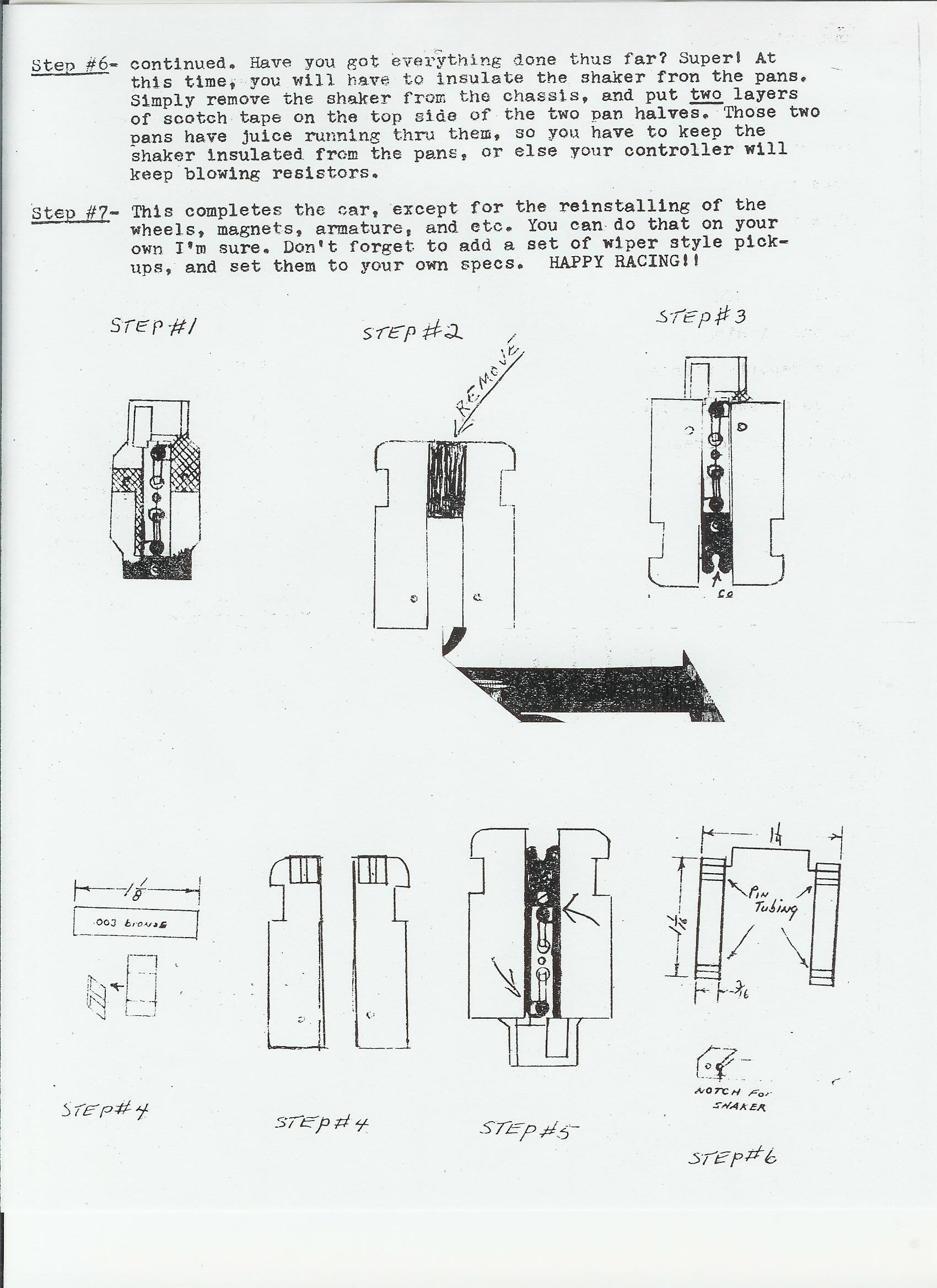
the later Afx pan cars. We were also replacing the shaker plate with a hinged
one with pin tubes almost identical to the ones later fabricated on the Afx
pan car. We raced Riggens for about a year and then pan cars for about 3 years
until they figured out we didn't need the pans.
Then the Afx came out and once a pan was mated to it then it was the car of
choice. It was the magnets all along that made it better, they had pull on the
rails, just enough to make them better. Remember, the T-Jet lock and joiner
track had massive rails compared to today’s Tomy and Tyco track. Then
Aurora decided to make a pan car and after marketing and production engineering
got done with the design it was the Super II, a lousy car that cost a lot. The
only good parts that came out of the Super II was the running gear, you know,
motor, magnets, 19 tooth crown and motor brushes and springs. One little note
that a lot of people don't know, before the Super II came out we used Riggen
and Tyco Pro 19 tooth crown gears in our pan cars, … The Tyco gear was
more rounded, the Riggen more square, I also always thought the Riggen one was
a little softer and less apt to break when installing on an axle.
Once it was determined that magnets were the way to go
Aurora made the Afx into the Magnatraction and HOPRA passed a rule that the
only magnets allowed on the car were the magnets to power the motor. Then the
pans slowly got smaller and finally disappeared so that by 1975 the car of choice
at a HOPRA was a Magnatraction with bronze wipers and steel stepped down shims
on the magnets. Even when Aurora came out with the G+, which was better than
the Magnatraction in stock form, the modified Magnatraction was still better
than the G+ for racing.
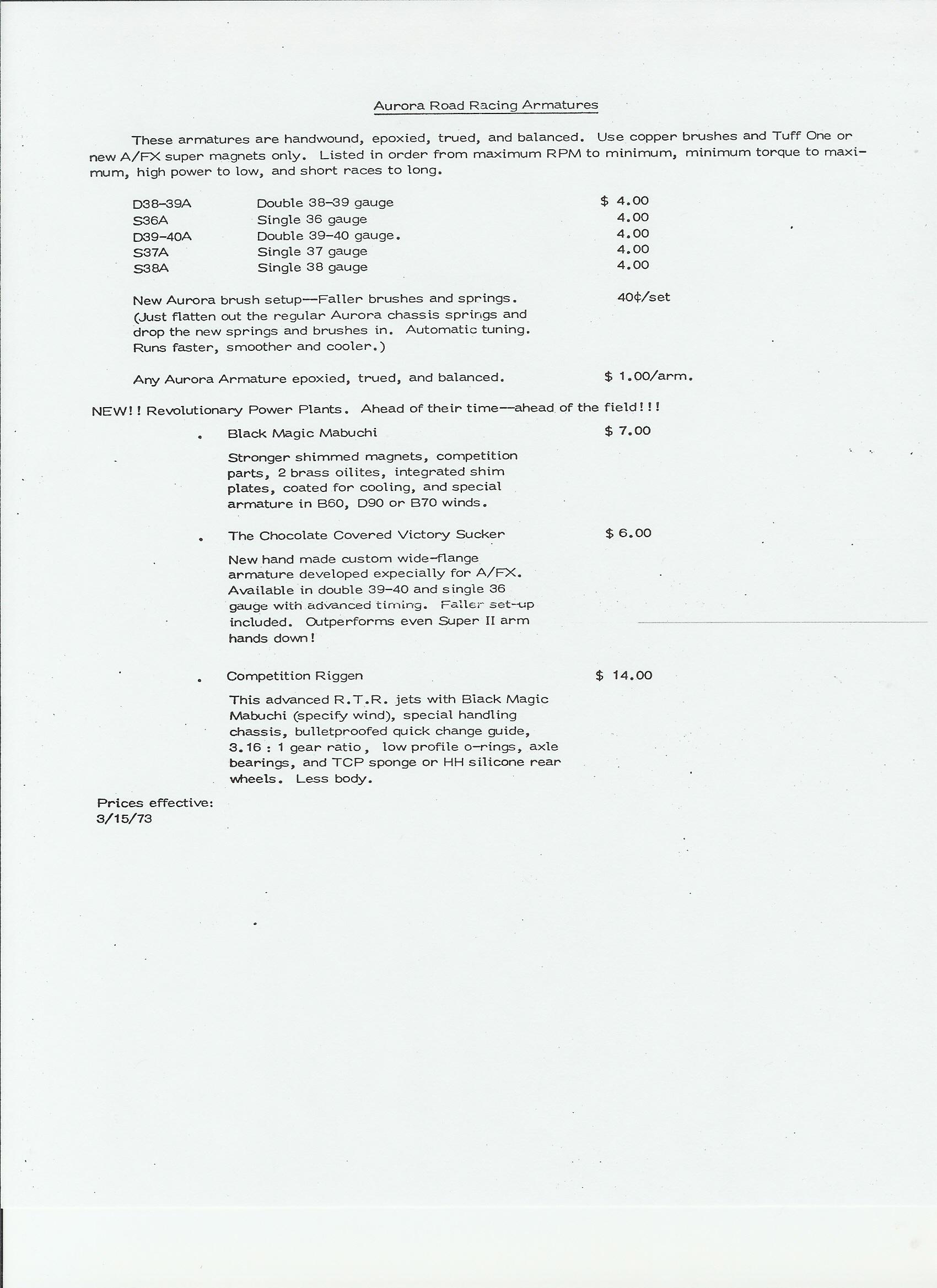
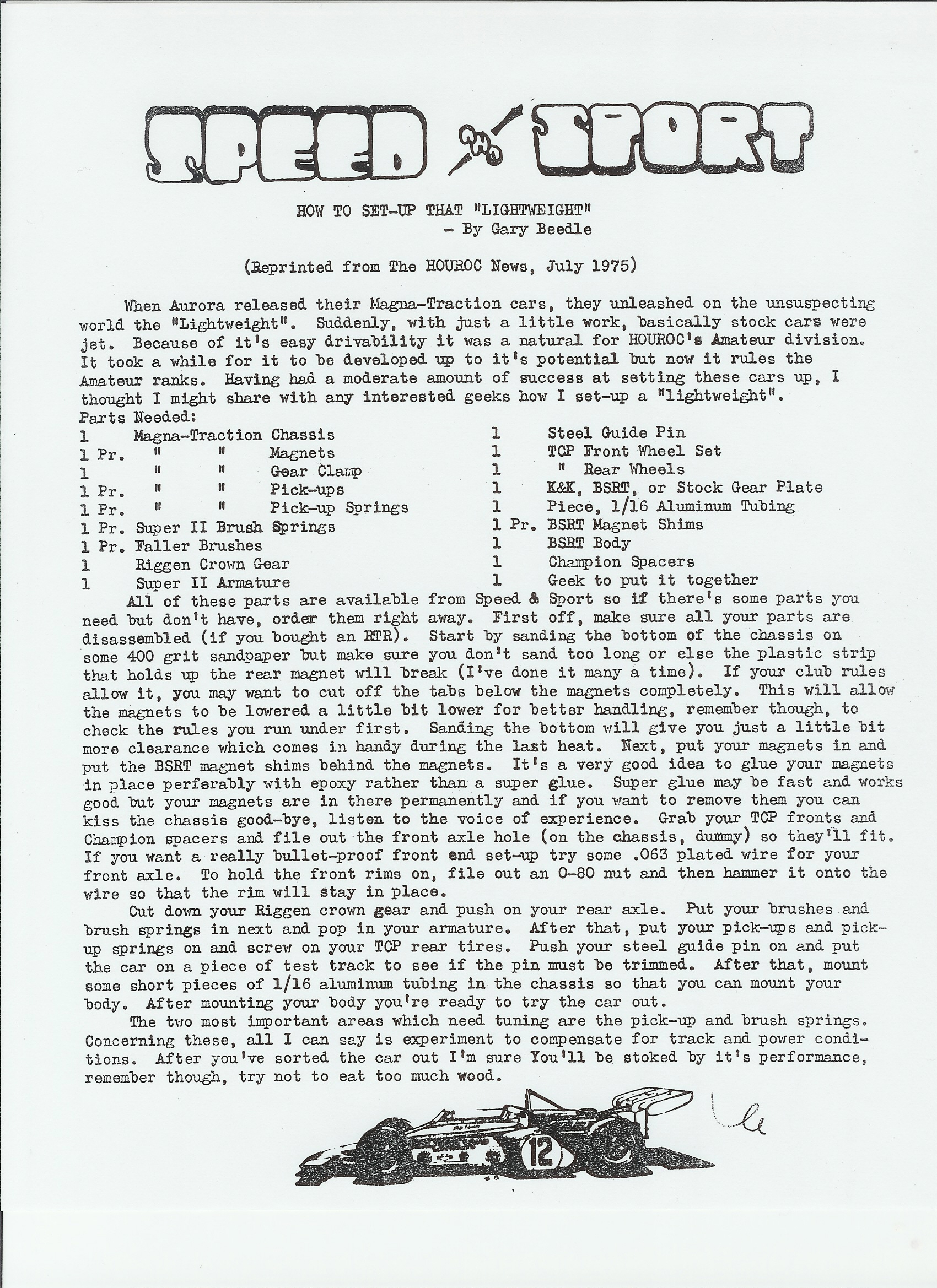
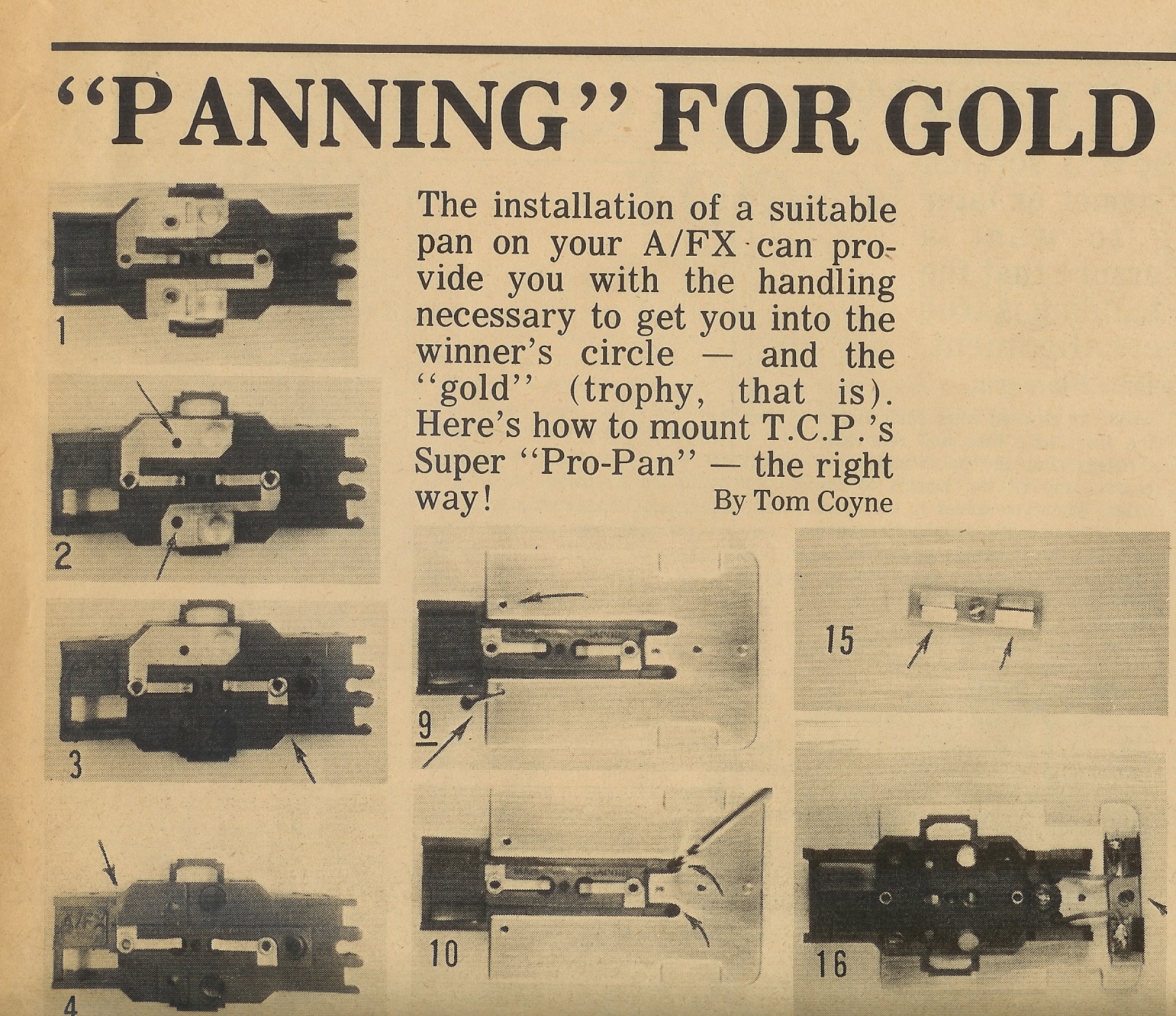
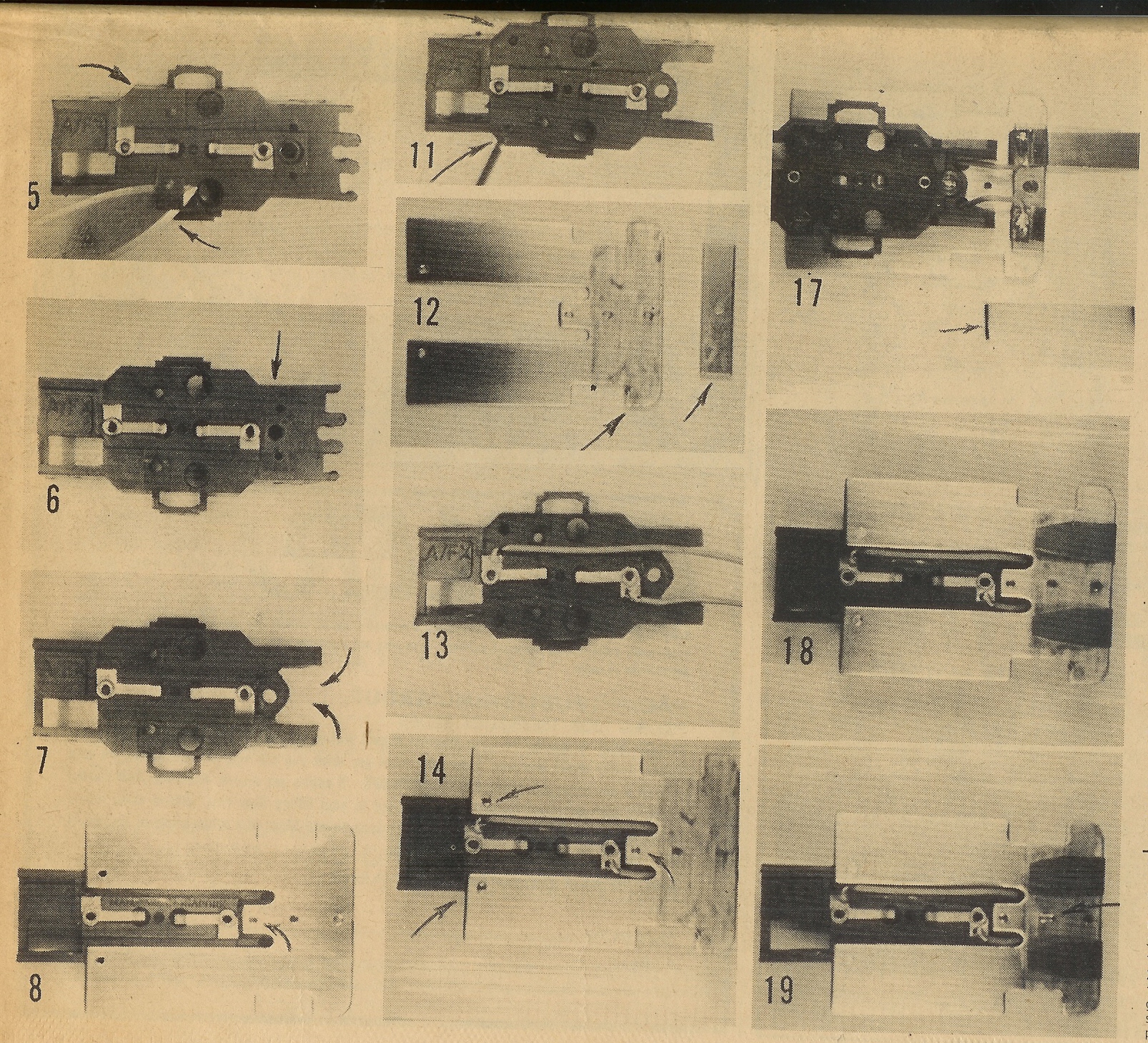
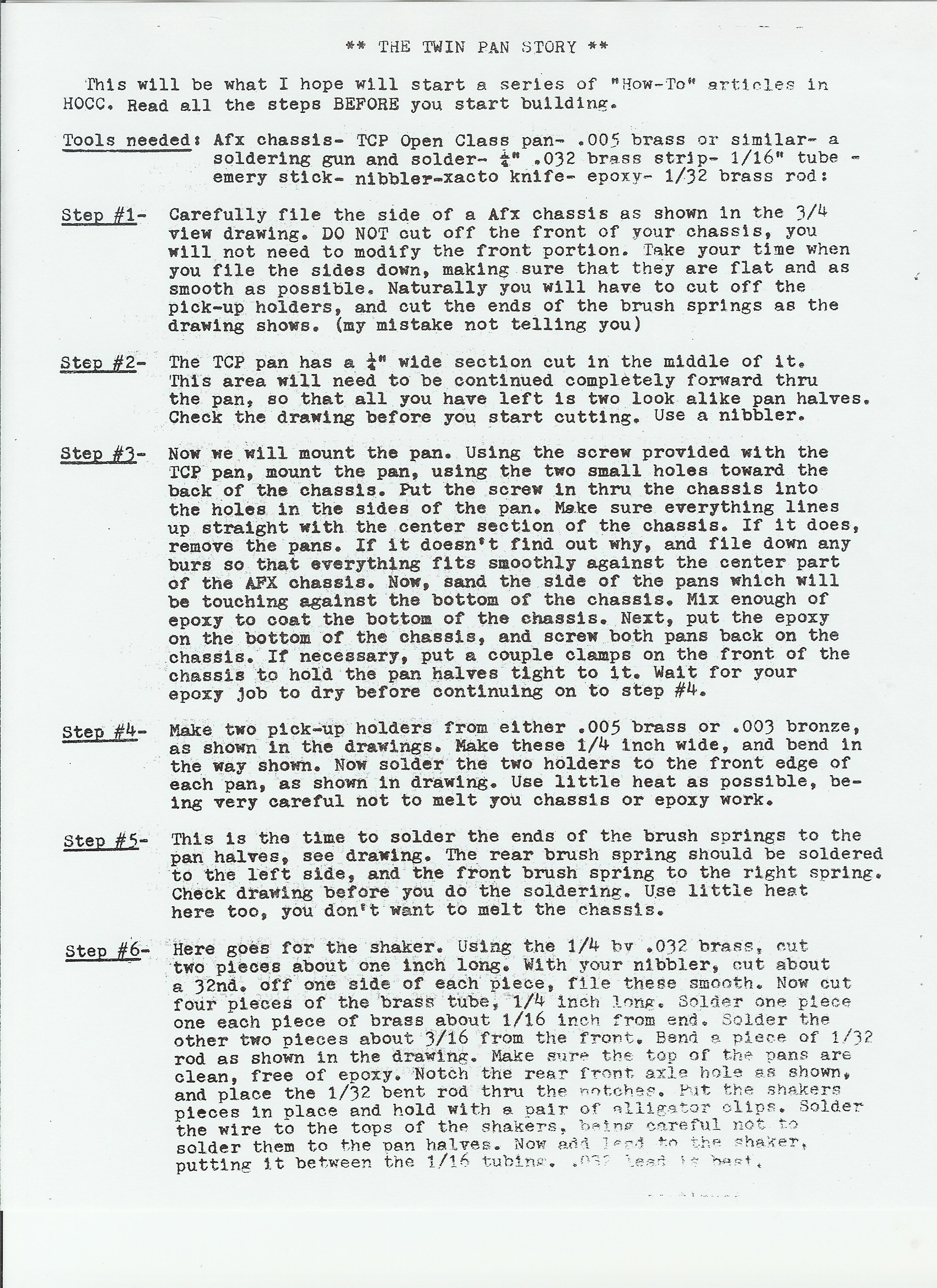
“I met Gary (Beedle) at the first HOPRA Nationals in 75 in Kansas City, won by Steve Brown. Tom Coyne raced in our club and most of the R&D work was actually done by a guy named Dave Livesay. I remember Marty (Thalison), always got my bronze from him, wish I could find it now. I also raced, or should I say got beat by Randy Kemp a few times. Randy Kemp was wheel chair bound also but he had full use of his upper body and could build cars, obviously wind arms and was a real good driver. The first time I ever saw a "magnet car" was in Elwood Indiana, Randy and his gang had them, they were just pan cars with toy magnets glued on. Most of them burned up, pulling the weight of pans and magnets but Randy won.
I really can't say for sure what part in that Marty (Thalison---Bronzeman) would have played, I don't know if you had ever met him but he was in a wheel chair and had very limited use of his hands. He must have wrote the text for Tom. He raced but he had to hold the controller up against his chest between his palms to operate it.
It's amazing how dumb we were when I look back. I mean we were all running pan cars and there was a HOPRA in Parma Ohio, the track was an 8 lane routed track built exactly like a 1/24th track, right down to the braid. We only ran six lanes because all we had were 6 lane race sheets. Gary Ryder out of Muskegon Michigan won it with an almost stock Riggen, the pan cars simply would not stay on the flat corners, the reason was simple, there were no steel rails. Then an old guy in the club, Russ Beal, he's not with us anymore, made a lowered magnet car (magnets sitting on the pan) that just out ran everyone and we thought it was because with those big heavy magnets lower in the car it further lowered the center of gravity. I mean magnets and steel rails were staring us right in the eye all along and we just didn't get it. “
…. I raced Indiana, Ohio, Illinois and Michigan HOPRA and once even went to a Kentucky HOPRA race, just to do it and the 75 Nats. Yes, after Russ lowered the magnets, the next step was to cut down the bottom of the chassis even further, cut the brush tubes down, cut the brushes and springs in half, even cut some off the end of the arm a little, difficult to get it working good.
The TCP brush tubes are far superior to the Super II ones, they are more square in the bottom corner and the springs set better. Speaking of springs, we used to use Faller springs and brushes. In order to do any of the cars with lowered magnets brush tubes are a must because the stock brush springs have to be removed.
The TCP quality control wasn't really that great, after the pans are drilled and tapped it looks like they were run across a very coarse file to somewhat flatten the bumps caused by the tap and knock the burr off the edges. Also the pan is not always symmetrical, like his guide for the holes or the die was off a little, and the front wheel cutouts are not always centered on the AFX axle hole front to back. The front ends that are soldered up on his pans are terrible quality, I mean the axle stub is positioned correctly but the actual pieces are cut off really crude. … But you know it's just like old cars, say my Corvair for instance, the fit of the hood, doors and deck lid are terrible, but the truth is it was a cheap car coming down an assembly line and when I go to a Corvair show 98% of them are just like it. The other 2% are over restored and although they look great they don't necessarily reflect the way they actually were.
I don't know about the Cigar Box wheels then being anodized, maybe that's what TCP fronts were, Tom was a clever guy, the hubs are basically a T-Jet hub with a flange. It would have been a good idea, the Cigar Box was a huge flop, wheels may have been plentiful and cheap.
The biggest deal with these cars was getting them to run smooth,
as was the same with the Riggen and scratch built can cars. … we were
running threaded axles which are probably not the most accurate, I assume that
was why they were eventually abandoned in 24th and HO. Tom would true the tires
and then we would true them on the car and once you get the car to run smooth
don't change the tires until they are wore out. A little trick I remember, and
this applies to all of the non magnet cars, if you are running threaded and
the car has a little hop, eyeball the tire real close while slowly turning it,
if it's a little out of round then it sometimes can be adjusted by threading
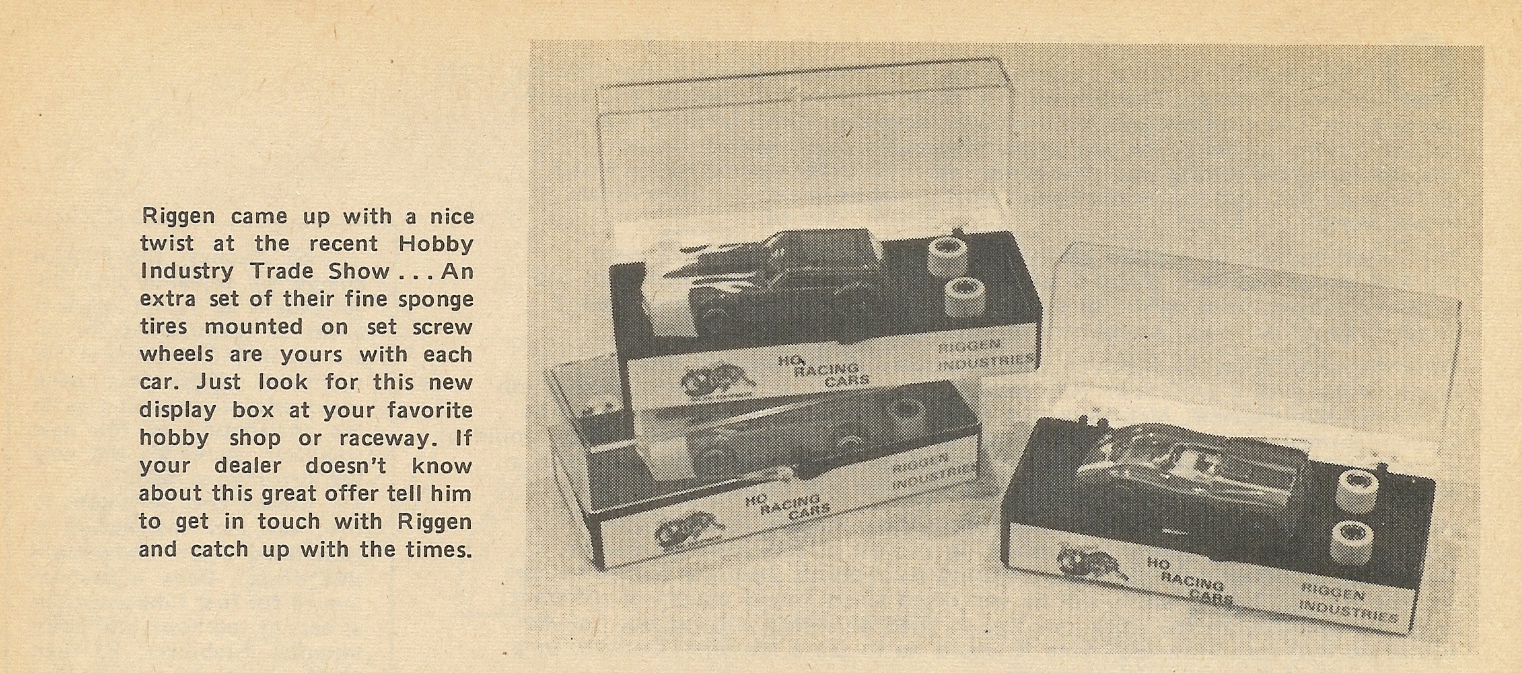
the tire out a 1/4 or 1/2 turn and tightening down the jam nut there . Riggen
was way ahead of everybody with the set screw tires, I'm sure they were more
accurate, I always ran TCP because it was a wider tire and Tom would put new
sponge on them for 50 cents. Plus, I could never afford the 5.00 Riggen with
the set screw tires, I always bought the 4.00 one with the push on tires. I
never even knew that Riggen made kits until I saw them on Ebay…
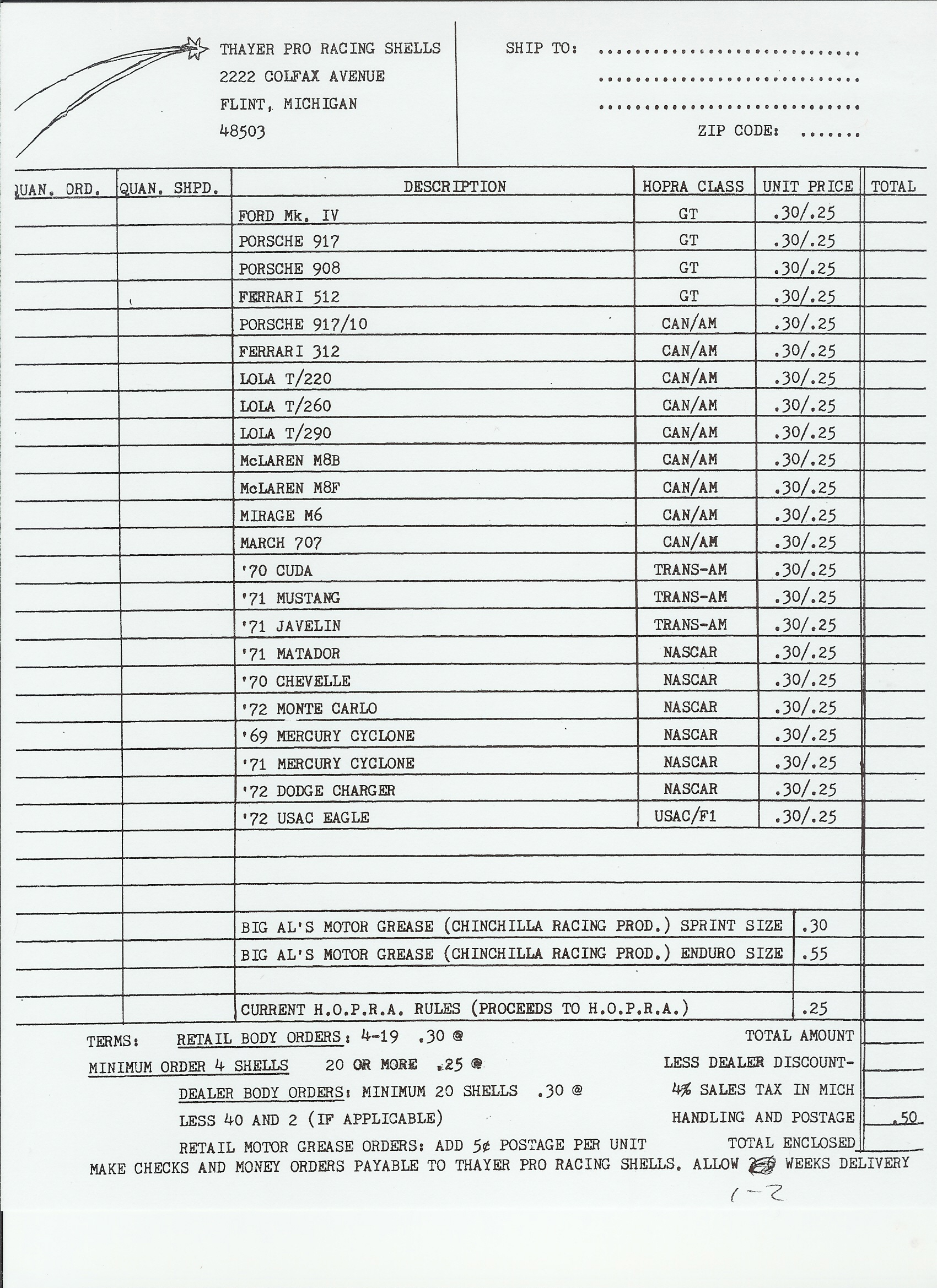
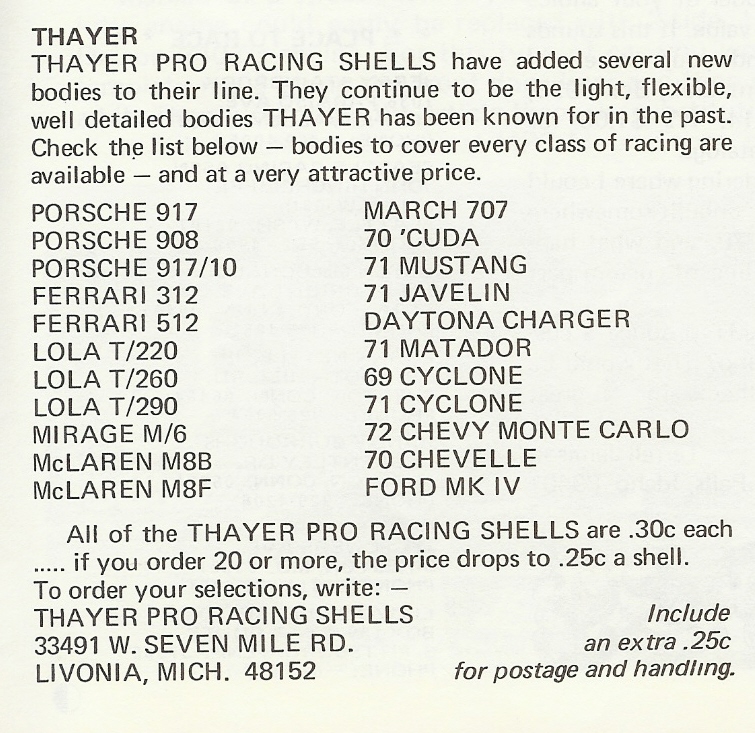
… the only bodies we ever had access to were the
Parma and Thayre. Bill Thayre was a member of the Westland club, near Detroit,
so of course he was at all the Michigan HOPRA races and always had bodies to
sell.
The Transition...
In the mid 1970's, it became obvious that traction magnets for HO were far more important than a chassis having the absolute lowest center of gravity possible. That fact, combined with slower growth rates for the slot car hobby overall led manufacturers to stay focused on tweaking their current cost effective plastic chassis designs, now augmented with magnets. The AFX Magnatraction chassis -- the basis of many of the best custom brass panned slots--lasted in some form from 1975 until the early 1980's. Aurora developed the G+ chassis in late 1975; an inline design featuring traction magnets which gently evolved through 1983. Tyco stuck with the TycoPro chassis in some form (ending with the TP2) through 1975, and then came the first of many iterations of the Curvehugger chassis--with traction magnets.
Parts makers such as AJ's and Champion also helped recreational/retail hobbyists improve performance with clever clip on/snap on/screw on parts that mimiced the theories practiced by the pro racers. These parts were very reasonably priced and very effective.
(AJ's weighted
pan, click image for larger view)
(AJ's front weight kit, the "poor man's" Super 2. Added weight and
allowed the use of light bodies)
(AJ's "ISO Pan", a cheap and EFFECTIVE brass upgrade) (AJ's
Brass Wiper system--like the one's the pros used!)
However.... with
the performance advantages and the commercial/retail acceptance of the traction
magnet, it seemed that the HO Brass Era was over
_____
Reader notes,
more history and driver's impressions....
This section will be updated from time to time with notes and
information provided by readers. Your contributions will be greatfully appreciated.
If you would like to add to this section, please contact us at ron@riggenho.com.
_____
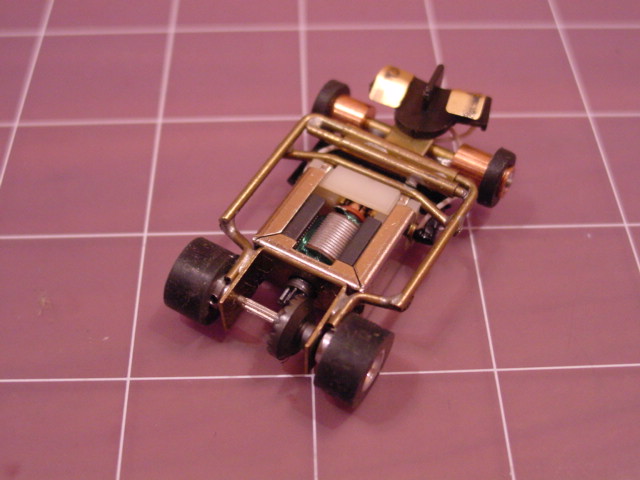
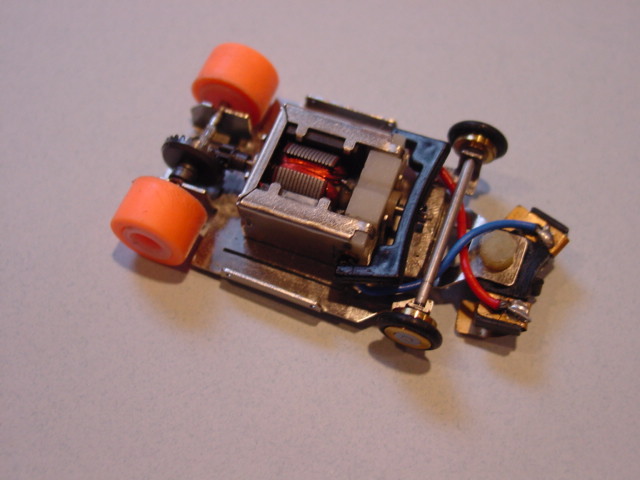
Examples of pan cars...
Click this link for more photos of AFX based brass pans raced in the day (JB Collection...9 pics)
The following links are pics of modern reproductions of the styles that were raced in the Midwest (HOPRA) built by old timer Doug Morris--I only use the term "Old Timer" because Doug was racing 40 years ago...I should say "long timer"!
car
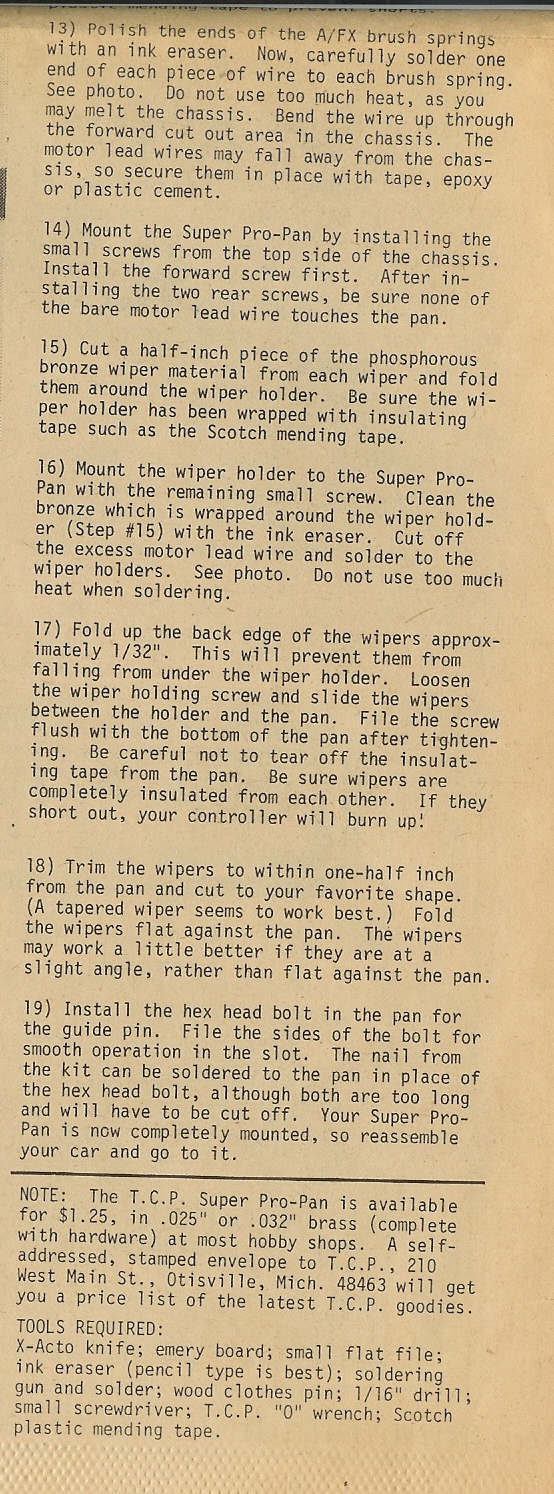
1--TCP Brass pro pan 1-A
car 2--TCP Steel Open Class Pan
car 3--TCP Brass Super Pro Pan .025
car 4--as above
car 5 and 6--Built exactly as directed from the
TCP Pro kits
car 7--"Lowered Magnets" car
car 8--Anglewinder
and....
car 9--NOT of the era...sold in 2005 on ebay
car 10--another new built like the old days
Other Brass or Pan style cars....

Click these links for more pics....
Vintage
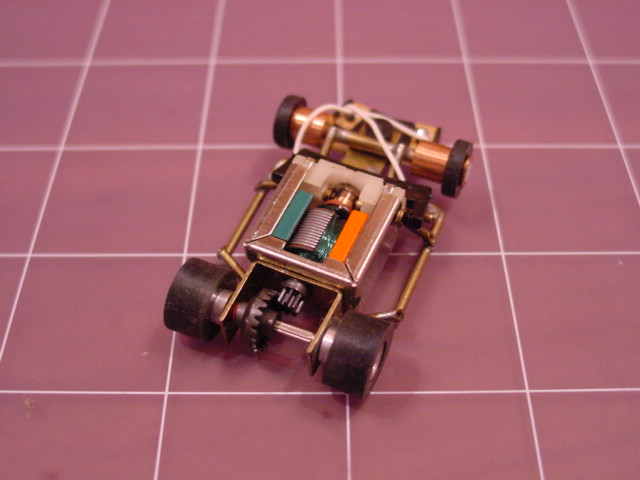
TycoPro with all the goodies from the Hop Up Kit
Vintage TycoPro with hot (green wire)
Champion motor
Scratch Modified Cobramite-there's
a lot of work in this car--check out the brass body screws!
Cobramite Scratchmite vintage chassis with modern parts (pic
1 pic
2)
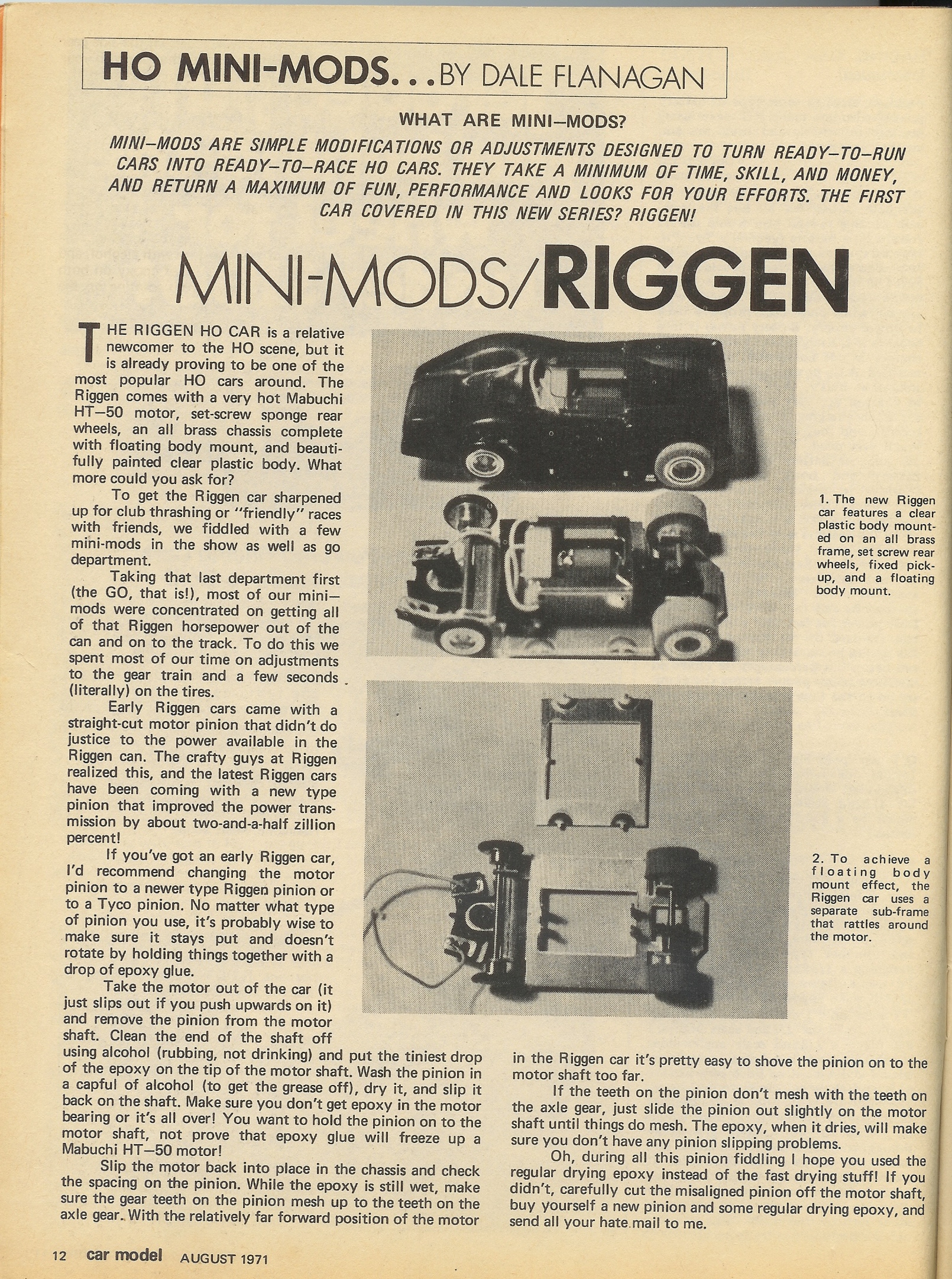
Vintage Riggen Boss with TycoPro hop
up gear, pin tube shaker and reworked guide flag
Vintage Riggen Boss with custom front
weights and very rare Riggen PLASTIC
front set screw wheels
More vintage BRASS added to the collection: Kircher
Lead Sled, Malone Anglewinder, Custom Dynabrute and Custom Cobramite
A little more history on the Dynabrute, Anglewinders, the Matchbox prototypes
Rebirth?
Here are some recent versions of HO Slot Cars that lean on the legacy of the
brass chassis...
RiggenHO
the 21 century version...
RiggenHO 3000 Series with pin tube
shaker, vintage braided flag with Dynabrute front weight! AWESOME!
RiggenHO Spena SuperModified
The Rattler
Winning Edge ISO
****Riggen Poly Carb-
the next generation RiggenHO chassis!
Rabbit Custom
Eckstein Chassis
-------
-----
------